






This report includes our audit quality scorecard results, commentary from our independent Audit Advisory Board, how we continue to deliver audit quality in how we work, insights into the modern audit and our work to support client conversations around audit quality.
Attached to this report is an appendix which covers how we are delivering on our commitment to audit quality. It sets out our policies, systems, processes and independence, as well as how we monitor our work and ensure our people have the support they need to thrive in the audit profession.
Welcome to our 2026 Audit Transparency Report
Audit quality is fundamental to trust in financial reporting and confidence in New Zealand’s capital markets. For us, that means more than meeting standards at the end of an engagement. High-quality audits depend on the structures, systems, technology and culture that support our people to make the right decisions consistently.
That is why our focus is increasingly on quality by design. We are continuing to embed quality into how audits are planned, resourced, executed and reviewed, with clear accountability throughout.
The way we deliver audits is also changing. Across global markets, increasingly complex business models, greater use of data and advances in AI are changing both the risks auditors need to assess and the tools available to respond. These developments are just as relevant in New Zealand. Today, our audits bring together New Zealand engagement team members, offshore Acceleration Centre colleagues, technology, AI trust and data specialists, and expertise across areas such as accounting, valuation, tax and IT.
Audit Transparency Report: Rich Day
Technology is an increasingly important part of this. Our investment in our next‑generation assurance platform, Maestro, is AI-native and brings together risk assessment, data-driven analysis and secure communication in an environment built around PwC’s global audit methodology and professional standards. This tool will help teams analyse information more deeply, identify anomalies and sharpen risk assessment, supporting our audits to be better, faster and smarter.
But technology does not replace judgement or accountability. Its value lies in improving the quality, consistency and focus of the audit and creating more capacity for the work where auditors add the greatest value, such as understanding a business, assessing risk, challenging assumptions, considering contradictory evidence and discussing complex matters with management and audit committees. Professional scepticism, experience and judgement remain fundamental.
Quality depends on culture. We want our people to feel confident to challenge, consult, speak up and understand the importance of the information entrusted to them. Clear expectations around independence, confidentiality, professional judgement and the appropriate use of information are part of the way we work, alongside secure technology and the wider systems that support audit quality.
At the same time, we continue to learn. Insights from our audits, quality reviews and root cause analysis feed back into our methodology, training, tools and ways of working. The objective is not simply more process, but an operating environment where quality is embedded in everyday decisions and supported by clear accountability, appropriate expertise and consistent ways of working.
As part of this, we are supporting stronger conversations about audit quality beyond our own firm. We have refreshed a practical resource to help boards and audit committees ask the right questions, assess auditor performance and make informed decisions about audit quality.
The profession will continue to evolve as technology advances, standards change and stakeholder expectations grow. Our focus is on continuing to adapt while maintaining the fundamentals of audit quality. We are confident in our quality systems and processes, but not complacent.
Thank you to our people for their ongoing commitment to quality, and to our clients, stakeholders and our Audit Advisory Board for the perspectives and challenge that help us continue to improve.

- Our 2026 Audit Transparency Report
- A note from our CEO
- Statement on the firm’s system of quality management
Our 2026 Audit Transparency Report
PwC is a multidisciplinary firm, however this report is focused on our audit and assurance practice in New Zealand.
In our report, we include:
- Our audit quality balanced scorecard for the year ended 30 June 2026.
- Commentary from our independent Audit Advisory Board.
- An overview of how we support consistent audit quality, including the evolving role of technology, multidisciplinary teams and our people, as well as a practical resource to support boards and audit committees in assessing audit quality.
In the appendix we cover a range of information, including:
- Our policies, systems and processes for quality management.
- How we monitor our work.
- Information on how our firm is governed.
A note from our CEO
Trust is fundamental to how markets and businesses operate, and quality audits play an important role in sustaining that trust. This report is one way we demonstrate our commitment to being transparent about how we approach audit quality, where we are progressing and where we continue to invest and improve.
Across global markets, rapid advances in technology, increasing business complexity and changing stakeholder expectations are placing new demands on corporate reporting and assurance. Maintaining that confidence requires continued investment in the foundations of audit quality. For PwC New Zealand, that means developing our people, strengthening the systems and processes that support them, and continuing to evolve how we work as businesses, markets and expectations change.
I’m proud of the dedication of our audit and assurance teams and the mahi they contribute every day. Delivering consistent quality depends not only on individual effort, but also on the environment around our people including clear accountability, access to specialist expertise, and a culture where people are encouraged to consult, challenge and speak up.
Independent challenge also plays an important role. Our Audit Advisory Board continues to bring valuable perspective to our work and to challenge us constructively as we consider how audit quality needs to evolve. I’d like to thank the Board for its ongoing contribution.
My own career began in audit, and that experience has stayed with me. Quality audits help underpin confidence in financial information and support well-functioning capital markets. We have a responsibility to keep earning that confidence through the quality of our work, the transparency of our approach and our willingness to continue improving.

Andrew Holmes
CEO and Senior Partner
PwC New Zealand
Statement on the firm’s system of quality management
During the year, we completed our evaluation of the firm’s system of quality management (SoQM) under ISQM 1 and PES 3. On behalf of PwC New Zealand, Andrew Holmes, our CEO, has evaluated whether our firm’s SoQM provides us with reasonable assurance that:
- The firm and its personnel fulfil their responsibilities in accordance with professional standards and applicable legal and regulatory requirements, and conduct engagements in accordance with such standards and requirements.
- Engagement reports issued by the firm or engagement partners are appropriate in the circumstances.
Based on all the relevant information of the firm’s SoQM, as of 30 June 2026 we believe our SoQM provides us with reasonable assurance that the quality objectives of ISQM 1 noted above are being achieved.
What is audit quality?
At PwC, ‘audit quality’ means that we consistently:
- Comply with ethical and auditing standards.
- Exercise professional scepticism.
- Use our experience and expertise to identify and resolve issues in a timely manner.
- Create a culture for our people to thrive in an evolving audit profession.
- Develop and equip our people with technology and tools that enhance audit quality.
- Focus on the wellbeing of our people and invest in their development.
- Apply a deep and broad understanding of our clients’ businesses and the financial environment in which they operate.
What does our audit quality balanced scorecard tell you?
Our audit quality balanced scorecard for the year ended 30 June 2026 provides a number of insights into audit quality at PwC New Zealand.
This year, PwC network internal inspections of PwC New Zealand audit files identified no non-compliant audit files (2025: none) and two audit files that were compliant with improvements required (2025: two). This is consistent with our objective of having zero non-compliant and minimal compliant with improvements required audit files.
Our positive PwC network internal inspection results also extended to PwC New Zealand’s non-audit assurance and non-audit, non-assurance engagement files.
Our experts and specialist teams continue to play a pivotal role in supporting audit quality. Audit teams can draw on their deep expertise when navigating significant or complex technical issues or higher‑risk areas. This collaborative approach helps ensure our audits remain robust and responsive in a challenging macroeconomic environment.
Our focus on quality is reflected in feedback from our people. In our Global People Survey 91% of respondents agreed that their teams engage diverse perspectives and consult with specialists, as needed, to perform quality work (2025: 93%).
The average score from our Leadership in Quality and Ethics Survey was 9.4 out of 10, showing that our leaders continue to set an appropriate tone at the top, focused on the importance of audit quality (2025: 9.4 out of 10).
Experienced team members, including our managers and engagement leaders, continue to deliver a significant proportion of audit hours at 25% of total audit hours incurred (2025: 25%). Our average staff retention rate has also remained stable at 82% (2025: 80%).
Our structured training programme continues to evolve in response to new tools and the changing skills required by our teams to deliver quality audits and support the expanding role of the auditor.
We continue to invest significant time in independence and ethics training for all client-facing staff and partners across the whole firm, including specific training on conflicts of interest, sensitive situations and confidentiality.
For the year ended 30 June 2026 Audit quality balanced scorecard
- Our drive for quality
- Consultations
- Our audit reporting
- Our tone at the top
- Our audit business
- Our people
- Our investment in training
Our drive for quality
As part of the PwC network, we are subject to globally coordinated quality inspections.

PwC is focused on having zero non-compliant and minimal compliant with improvements required engagements. Our PwC New Zealand file inspection sample sizes are small and the results of one file inspection greatly impacts the overall percentage. Our total number of files reviewed annually ranges from approximately 10 to 15.
PwC network internal inspections of non-audit assurance and non-audit, non-assurance files
Our positive PwC New Zealand file inspection results continued across our non-audit assurance and non-audit, non-assurance engagements, with 80% rated compliant and 20% rated compliant with improvements required (FY25: 100% rated compliant).

Across the PwC network internal inspection programme and our real time engagement review programme, our engagement leaders are reviewed at least once every three years, and generally every one to two years.1

(1) Further information is available in the Real time engagement review programme and our Inspection programmes sections of Appendices B and C, respectively.
Consultations
Our Risk and Quality (R&Q) and technical accounting specialists play a pivotal role in supporting audit quality.

(1) Formal consultations cover assurance opinions and reports, complex engagement issues, high-risk or unusual reporting matters, and reviews of financial statements and technical accounting treatments.
Our audit reporting
We are committed to delivering high quality audits and being transparent with the relevant stakeholders. The goal is decision-useful, transparent reporting that shows where we focused our work and why.

These are audit reports that include material uncertainty with respect to going concern.
KAMs provide transparency about the matters that, in the auditor’s judgement, were of most significance in the audit of the financial statements.
Our tone at the top
We survey our people to collect feedback on the behaviours that support audit quality demonstrated by our leaders.

(1) The survey seeks to measure the engagement leader and engagement quality reviewer’s leadership in quality and commitment to ethics throughout the engagement. In FY26, the reporting period for the Leadership in Quality and Ethics survey was shortened following a change in the survey reporting cycle.
(2) Our leaders continue to set an appropriate tone at the top, focused on the importance of audit quality.
(3) This global PwC survey is undertaken annually to measure employee engagement. The scores represent the percentage of our team that agreed with each statement.
(4) We continue to have high levels of participation from our staff and partners.
(5) The engagement score is an average from a number of specific questions focused on how a person is engaged with/connected to an organisation.
(6) Audit quality remains at the core of what we do. Audit teams can draw on our network and our specialist teams’ deep expertise when navigating complex technical issues or higher‑risk areas.
(7) Understanding changes from all perspectives is important to ensure we continue to deliver quality services.
(8) We are focused on helping our team understand the importance of audit and why what they do matters.
Our audit business
Our audit business is a significant part of our firm and New Zealand’s capital markets. We safeguard independence and structure teams so experienced managers and partners invest the right amount of time and are supported by specialists where needed.

These graphs illustrate the percentage of time spent on our audits by the different roles within an engagement team. Consistent with the prior year, a significant portion of total audit hours are invested by experienced team members.
(1) Investors often focus on the ratio of other service fees compared to audit and assurance-related fees when considering the independence of an auditor. A lower percentage shows the auditor has done little other work relative to audit and assurance-related services.
(2) Indicator of the relative size of the audit practice compared to the rest of the firm. Our audit practice remains a critical component of the firm.
Our people
The experience and expertise of our people is critical to delivering quality audits. We are also committed to helping build the next generation of auditors.
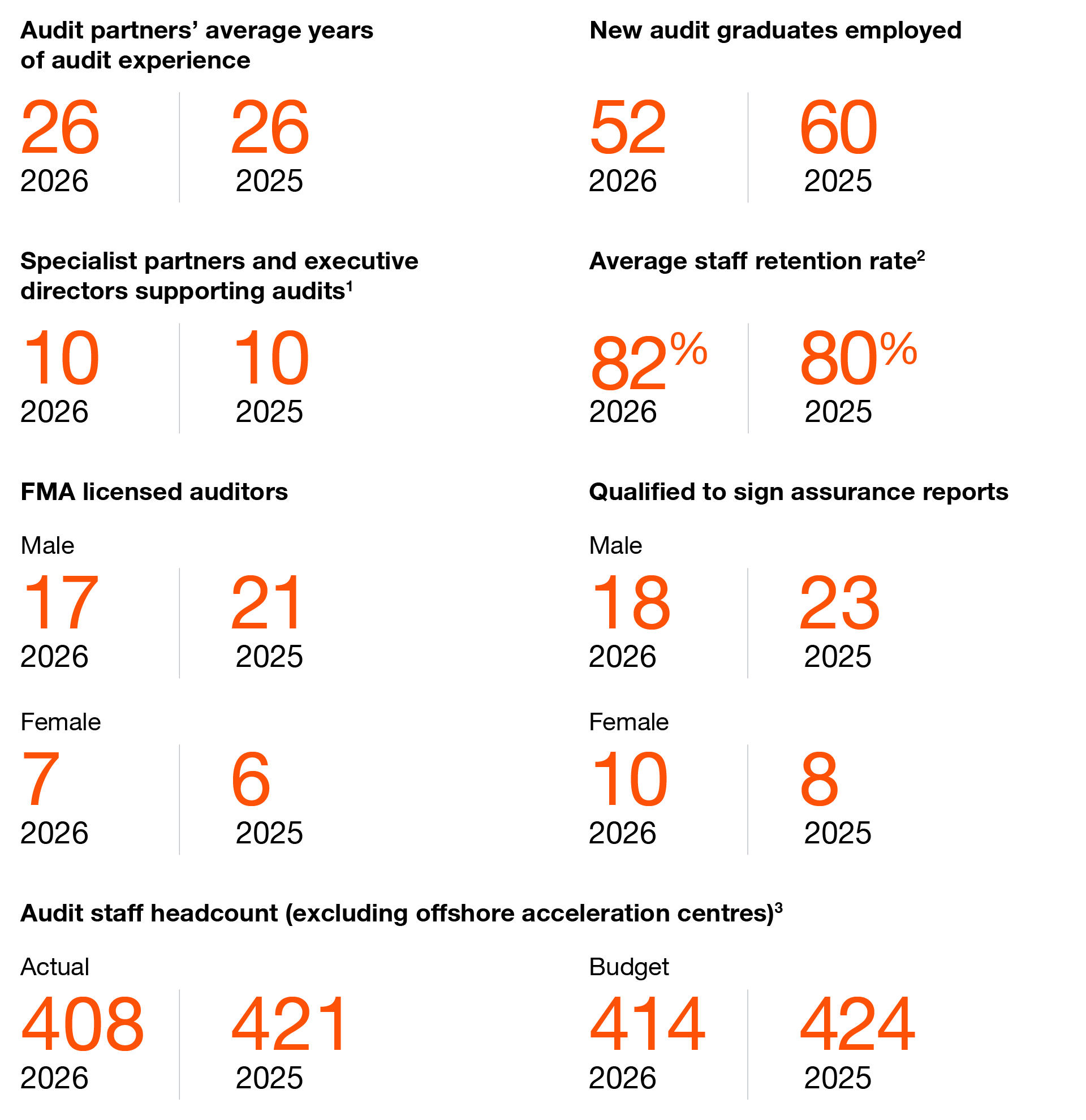
(1) Supporting audits in the areas of technology, valuation, complex accounting matters and specialist actuarial support.
(2) Our average staff retention rate has remained stable and relatively in line with historic levels.
(3) Our on-shore headcount has reduced in line with budget as we continue to maximise the output from improvements in technology, methodology and output from our acceleration centres.
Our investment in training
We invest in our people to ensure they have the skills to continue performing quality audits, leverage digital tools and support the expanding role of the auditor.
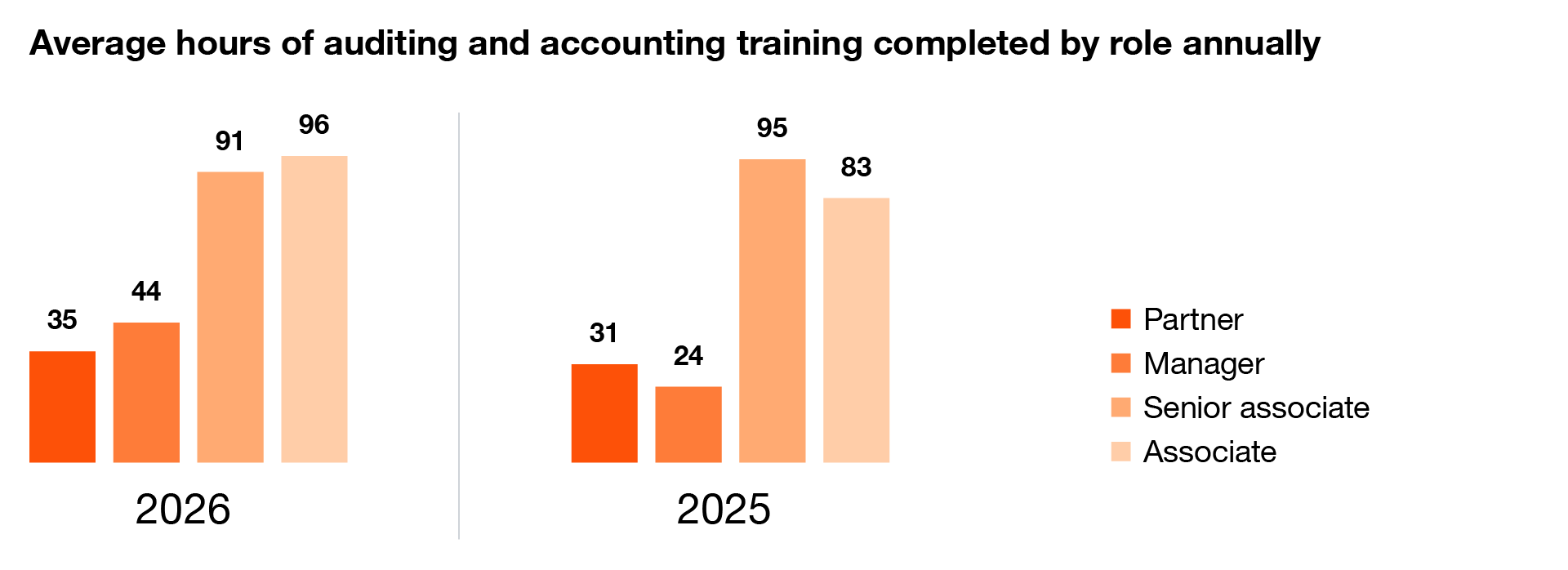
PwC New Zealand audit staff and partners consistently exceed the minimum structured continuing professional development (CPD) requirements set by CA ANZ and CPA Australia.
Beyond the base required levels, training can fluctuate depending on the release of accounting and auditing standards. Our approach to structured training remains agile to respond to the use of new tools and skills required of our teams to continue to perform quality audits and support the expanding role of the auditor.

Some of our independence and ethics training is run annually whilst other training is biannual. This also includes specific training on conflicts of interest, sensitive situations and confidentiality.
Audit Advisory Board Report 2026
By Alison Posa, Chair
Audit quality lies at the heart of trust for clients and financial markets alike. Boards, investors and the wider public must be able to rely on the information that underpins their decisions, and they look to audit firms to provide that trust. The Audit Advisory Board’s role is to bring an independent outside perspective to a key question: how does PwC New Zealand ensure that trust is justified?
Our work during the year addressed that question in five ways.
1. Reviewing quality outcomes
We reviewed outcomes from external reviews, PwC network inspections and the firm’s internal reviews. Inspection results show quality targets were exceeded or met and performance continues to improve. The rigour with which root causes are identified and learnings incorporated shows a commitment to continuous improvement.
2. Understanding quality management processes
We discussed the processes PwC uses to manage quality, understanding whether they are robust, well integrated and consistently applied. A critical question for the future is how those processes incorporate Maestro, PwC’s new AI-native audit and assurance platform.
3. Focusing on leading indicators of quality
Inspection results describe the past, so we looked for signals of future quality. These included people survey feedback, independence processes and results, and the firm’s commitment to developing professionals who confidently exercise judgement, challenge assumptions and understand clients’ businesses.
As seen in the audit quality balanced scorecard, the people engagement score remains high at 81% (80% in 2025), and the results from the leadership in quality and ethics surveys are excellent at 9.4 out of 10 (9.4 out of 10 in 2025).
4. Meeting the teams
Quality is ultimately delivered by people. We heard from teams who contribute to audit quality and questioned them about their work, the challenges they face and the support they receive.
The way PwC delivers audits is changing, and technology and offshore Acceleration Centres are an important part of that. We examined how offshore Acceleration Centres are governed and how their work is integrated into the wider audit process. Maestro will enable deeper, more efficient analysis, allowing audit teams to sharpen their focus on insight and challenge while keeping human judgement at the centre of audit opinions. The Audit Advisory Board gained confidence that teams are energised by this opportunity and are receiving training and development designed to capture the quality gains from faster data analysis, deeper understanding and sharper risk assessment.
As in previous years, we were impressed by the talent in PwC’s audit and assurance practice.
5. Considering governance of the broader organisation
Audit quality depends on the organisation around it. We met with the Chief Risk Officer, Chief Executive and Chair, and held robust discussions on how the firm’s broader leadership and governance protect the processes that safeguard audit quality. We were encouraged by the openness of these discussions and the priority leadership places on quality.
Looking ahead
The environment for businesses and auditors will remain demanding. Rapid technological change, economic uncertainty and rising stakeholder expectations will continue to test the profession.
The Audit Advisory Board continues to see its role as supporting and constructively challenging PwC’s audit and assurance practice.
The focus we set ourselves a year ago, on the quality implications of what is nothing less than a technology revolution, remains relevant.
Alison PosaChairIncreasingly, quality will be judged not only by whether PwC consistently delivers audits that exceed the expectations of regulators, investors and clients, but also by the trust it can inspire in the systems and processes of clients rapidly integrating AI into their businesses. As clients, financial markets and other stakeholders seek assurance beyond financial statements, including over sustainability information and the integrity of AI-enabled processes, PwC’s audit and assurance practice is well placed to meet these broader needs.
Once again, the practice can be justifiably proud of how it has met these challenges.
How we deliver consistent audit quality
Our approach is centred on quality by design. We build the conditions for quality into each audit from the outset, influencing how work is planned, resourced, carried out and reviewed, and how teams access support when complex issues arise.
Clear accountability is central to this. Engagement leaders remain responsible for the audit, supported by experienced teams, specialists and our wider quality functions.
Consistency is also important. Our methodology, workflows and quality checkpoints are designed to help teams identify risks and issues early, escalate matters when needed and direct attention to the areas of greatest significance.
And we continue to learn. Insights from our audits, quality reviews and root cause analyses feed into improvements to our methodology, training, tools and ways of working to identify issues earlier and improve consistency across our audits.
Together, these elements support an environment where quality is part of everyday decision-making, underpinned by clear accountability, appropriate expertise and a culture that encourages professional scepticism, consultation and challenge.
The modern audit Connected, technology-enabled and multidisciplinary
The way audits are delivered continues to evolve as businesses and finance functions become more digital, complex and data-rich.
Today’s audit brings together a broader range of capabilities than the people working directly on-site with a client. Our engagement teams work alongside Acceleration Centre colleagues, technology and data specialists, and experts in areas such as IT, tax and valuations.
These capabilities are increasingly integrated into the audit from the planning and risk assessment stage, rather than brought in only when a particular issue arises. This multidisciplinary approach helps teams identify and understand complex issues earlier and strengthens their ability to challenge management effectively.
Acceleration Centres are an important part of this operating model. Dedicated teams can perform appropriate standardised and repeatable audit activities consistently, while building deeper expertise in particular procedures. Working across locations and time zones also extends the capacity and responsiveness of the wider audit team. This allows local teams to spend proportionately more time understanding the business, assessing risk and addressing areas requiring significant judgement.
Technology is also deeply integrated into the audit workflow. Our investment in Maestro, PwC’s next generation assurance platform, brings together risk assessment, data-driven analysis and secure communication in an AI-native environment built around PwC’s global audit methodology and professional standards. It will help our teams interrogate data more deeply, identify anomalies and sharpen the focus of risk assessment.
Technology is not simply about delivering the same audit with fewer hours of human effort. Its value lies in strengthening quality and consistency, supporting deeper analysis and helping teams focus their time and attention on the areas that matter most. Delivering audits that are better, faster and smarter.
These changes create greater capacity for auditors to focus on complex matters, significant risks and areas requiring challenge and discussion with management and audit committees. They can also give audit committees greater visibility into the audit process and the areas receiving the greatest attention.
Human judgement remains central. Technology can support analysis and surface relevant information, but audit judgements remain the responsibility of our people.
Outputs need to be interpreted and evaluated by experienced professionals, with engagement leaders retaining accountability for the audit opinion.
The modern audit is therefore more than a digital version of the traditional audit. It is a connected, multidisciplinary and increasingly technology-enabled model, with professional judgement, scepticism and accountability at its centre.
Building trust in an AI-enabled world
As organisations increasingly adopt AI, trust in how these technologies are governed and used is becoming an important business and assurance consideration. PwC New Zealand is bringing together existing capabilities and experience across AI governance, data, security, model risk and controls to respond to emerging assurance needs.
For our audit practice, this means understanding how AI is becoming embedded in clients’ business processes, systems and controls, and considering the implications for the audit where relevant. This builds on our investment in AI capability and responsible use of technology, while recognising that human judgement, professional scepticism and accountability remain fundamental to high-quality assurance.
Drawing on PwC's global experience and emerging approaches, we are continuing to develop our capabilities in New Zealand. We expect independent assessment and assurance to play an increasing role in building confidence in AI‑enabled systems.
PwC is #AuditorProud
Auditor Proud is a global day recognising auditors and their role. At PwC, we recognise the important work our audit teams do over a week-long period. Get a closer look to why our team members are #AuditorProud
Supporting conversations about audit quality
Audit quality is not only about how audit firms operate. Boards and audit committees also play an important role in setting expectations, challenging auditors and making informed decisions about audit quality and performance.
To support those conversations, we have refreshed a practical, evidence‑led guide for boards and audit committees. It is designed to help them assess whether their external auditor remains independent, capable and effective, and to support robust decisions about auditor performance, continued appointment and tenure.
The guide brings together the questions and evidence boards should consider and a practical approach to assessing audit quality throughout the audit cycle. It includes an annual assessment toolkit covering five areas of audit quality, a self-review of the board’s contribution to audit quality, and practical tools to support evidence-based decisions and shareholder communication.
It also provides guidance on periodically reviewing the auditor relationship, including weighing the benefits and risks of continuity and considering when a more comprehensive assessment may be appropriate.
The guide builds on the transparency provided in this report and is intended to support clearer, more informed and evidence-based conversations between boards, audit committees and auditors about what good audit quality looks like in practice.
Guide for Assessing external audit quality and auditor performance
Audit Transparency Report 2026
Delivering on our commitment to audit quality. Download a copy of our complete report.
Appendix
In this document we outline our policies, systems and processes for ensuring audit quality and independence as well as how we monitor our work and ensure our people have the support they need to excel in their work.
About the author(s)