





Overview
From the CEO
29th CEO Survey - PwC New Zealand
The 29th PwC CEO Survey, New Zealand shows CEOs have begun 2026 with a sense of cautious optimism about the economy in general, and their revenue growth in particular. Unlike many of their global peers, they have been less impacted by geopolitical issues and are poised to take advantage of better operating conditions.
Yet, there is something concerning our business community. It’s being left behind with outdated business models, unable to take advantage of new technology, specifically AI. In this respect they are very much in tune with their global peers, as the data is clear that across the board, awareness of AI is high, for companies of every size and in every nation, but effective deployments are low.
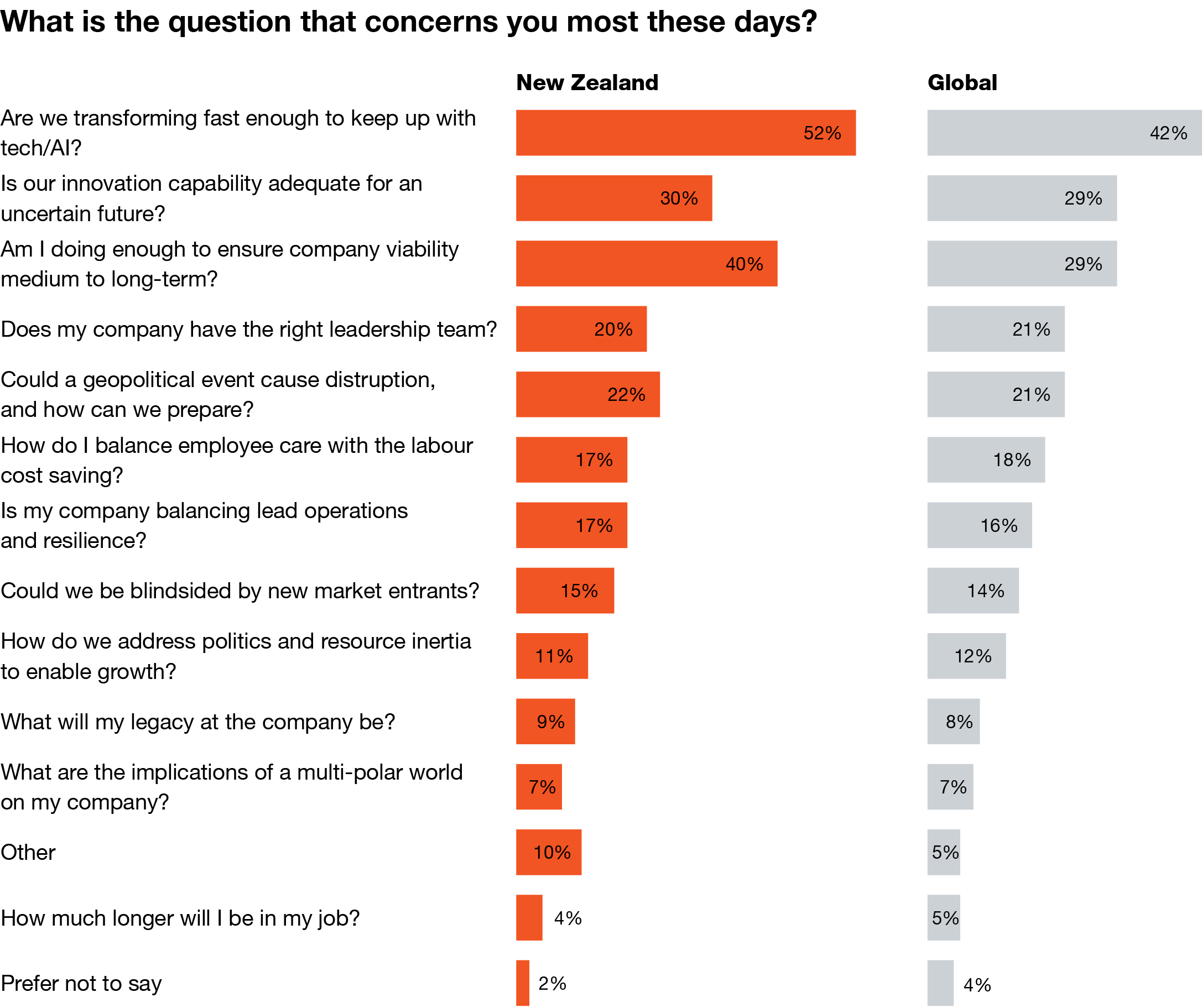
- 52% of New Zealand respondents cited their greatest concern as not transforming fast enough to keep up with tech/AI. This was also the biggest concern for their global peers.
- This is despite 64% of local respondents stating that their organisational culture is ready for AI, and 70% considering their technology is capable of supporting it.
- In practice however, over 78% have yet to see AI have any impact on their organisation, and only a minority are reaping any benefits from AI to their bottom line.
The good news is that achieving rapid gains from AI is possible, as we are seeing in companies across the PwC network globally. Those benefiting from AI view it as an enabler, not an endgame, and are paying as much attention to ROE, Return on Experimentation, as they are to ROI.
By moving quickly from pilots to programmes, these CEOs understand that AI is a foundational technology and that it’s the choices business leaders make that determine outcomes. And while speed matters, it mustn’t come at the expense of trust.
It’s why I’m so energised by the findings in this report. They clearly show that those CEOs who grasp the importance of strategic leadership, set a clear direction, and practice good governance, will set themsevles up well for the future.
My sincere thanks to the CEOs who participated in the survey and generously shared their experience and perspectives. This data is key to ensuring this report provides our business community with useful insights, on which they can act with confidence and conviction in the age of AI.
As we say at PwC – transform today, build for tomorrow. Let’s make 2026 the year of execution.

Andrew Holmes
CEO and Senior Partner
PwC New Zealand
58%
of CEOs expect economic conditions to improve.
91%
of CEOs are confident about revenue growth this year.
What do our findings mean for you?
Partner Alex Wondergem looks at the confidence levels of New Zealand business leaders regarding their company’s performance in the coming months. He also shares their top three concerns, which show why in their optimism is being tempered by caution.
70%
of CEOs believe their technology is ready for AI.
78%
of CEOs report say that AI has had little or no impact on their organisation.
What do our findings mean for you?
While many companies report that their companies are AI-ready, they are struggling to see real gains from its implementation. Partner Scott McLiver discusses why that is, and how CEOs can achieve greater ROI from their tech investment in 2026.
54%
of companies have expanded into new sectors in the last five years.
13%
of CEOs report having an innovation or venturing function to a large/very large extent.
What do our findings mean for you?
New Zealand CEOs understand the importance of expanding into new sectors and investing in innovation but, as Partner Phil Wheeler discusses, they are not investing sufficiently in reinvention. He points out that the best performing companies are those that build their capacity to innovate, even in tough economic conditions.
33%
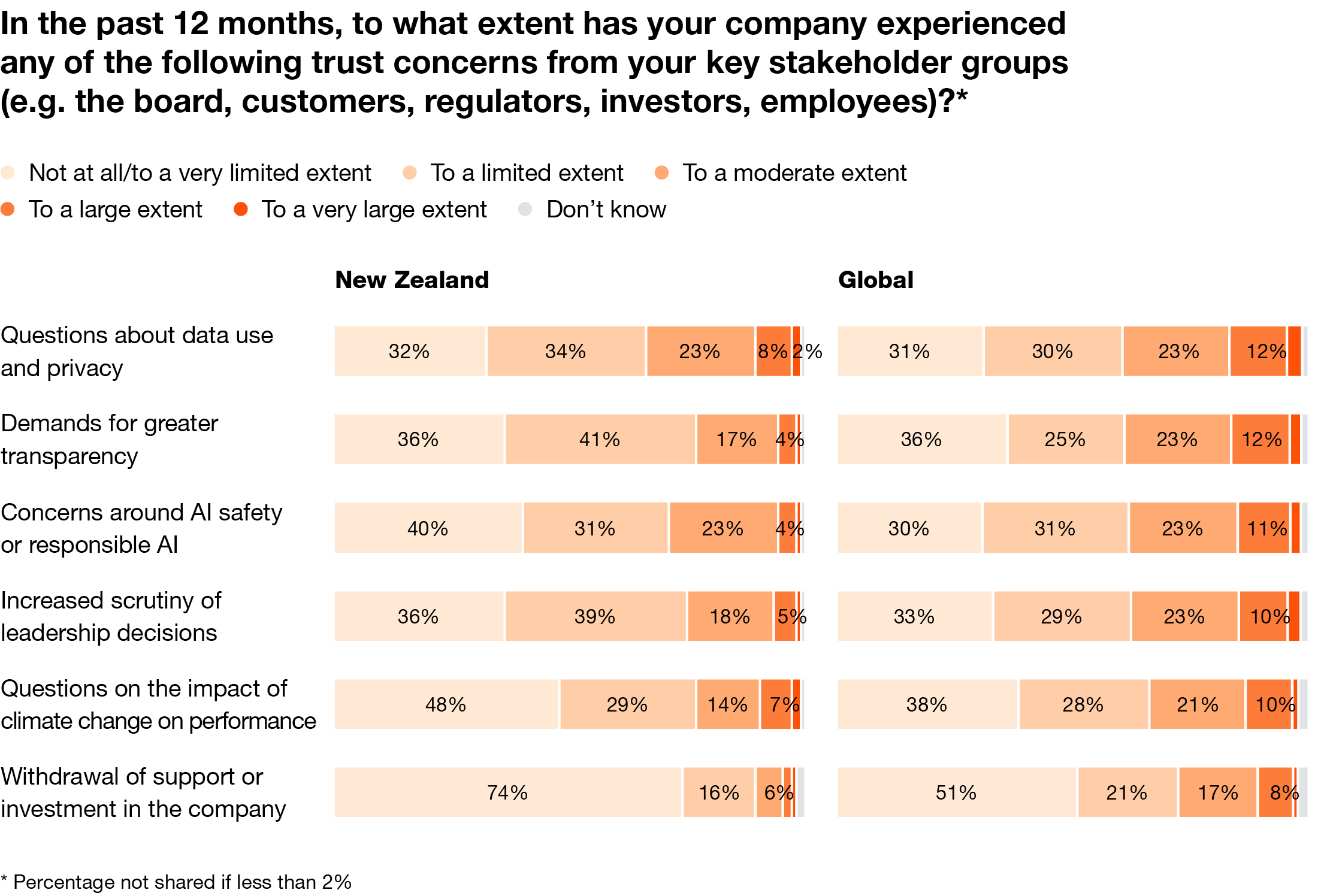
of CEOs experienced a trust concern related to data use and privacy to a moderate to very large extent in the past year.
37%
of CEOs believe their C-suite is well-prepared for disruption.
What do our findings mean for you?
Partner Pip Cameron explains that while AI, data and tech raise trust issues for companies, this should not deter them from taking advantage of the step-change in productivity and innovation they enable.
“The key is to expect disruption and be ready to mitigate its negative impacts.”
Optimism tempered by caution
New Zealand CEOs enter 2026 with cautious optimism, balancing steady confidence with an acute awareness of structural change.
Over half of survey respondents (58%) expect economic growth to improve in New Zealand, which is similar to last year and puts them in line with their global peers, where optimism for economic growth sits at 55%. This confidence is underpinned by resilience to external shocks: 73% of New Zealand respondents report little or no impact from geopolitical uncertainty, significantly higher than the global average of 54%, and only 6% of local CEO respondents say the impact has increased.
Financial performance reinforces this position. New Zealand CEOs report revenue growth of 9% in the most recent fiscal year, alongside a net profit margin of 13% and return on assets of 6%, a little behind global counterparts.
Looking ahead, confidence remains solid. With 91% confident about revenue growth over the next 12 months and 34% very or extremely confident, which exceeds global levels (30%). Optimism strengthens further over the three-year horizon, with 55% of New Zealand CEOs are confident/extremely confident on revenue growth, which is higher than their global peers (49%) in future revenue growth.
However, this confidence is tempered by concern. The dominant challenge for local and global CEOs alike is whether their organisations are transforming fast enough to keep pace with rapid advances in technology and AI, alongside questions over innovation capability and long-term business viability.

Alex Wondergem
Partner
PwC New Zealand
New Zealand business leaders continue to show signs of optimism about the country’s economic growth and are reasonably confident about their own revenue growth in the near to medium term. Despite 2025 not delivering the gains we hoped for, we are starting to see the economy take a more positive turn.
New Zealand CEOs report being less exposed to geopolitical uncertainty, including tariffs, than global counterparts. This reflects the reality of being a small economy positioned in an area of the world, largely removed from where global issues are playing out.
The area of most concern for local business leaders is falling behind in AI and technology. This indicates that companies are still grappling with the AI opportunity and how it can enable them to reinvent their business in a way that ensures it will thrive in the long term.
AI potential yet to be realised
New Zealand business leaders report strong confidence in their readiness for AI. Nearly two-thirds (64%) say their organisational culture enables adoption, broadly in line with the global figure (69%). Seven in ten (70%) also believe their technology environment supports AI – above the global average (66%).
More than three-quarters of New Zealand respondents say AI is not used at all or to a limited or moderate extent across core functions such as demand generation (89%), support services (87%) and product service and development (85%).
This is reflected in outcomes. In 2025, 75% of New Zealand respondents reported AI had little to no impact on their organisation, compared with 60% globally. Financial results mirror this: 78% in New Zealand saw minimal revenue impact, and 53% reported little to no cost impact from AI adoption.



Scott McLiver
Partner
PwC New Zealand
New Zealand business leaders are confident they’re ready for AI, and many expect it to materially influence operations over the next three years. The challenge is not awareness – it’s execution. For most organisations, AI is still concentrated in pilots and pockets of use, which limits value realisation.
Globally, CEOs are seeing stronger results across key measures such as revenue uplift and cost reduction. That should be a clear signal: the window to build advantage is open, but it won’t stay open for long.
Over the next 12 months, the priority is to shift from experimenting with AI to systematically delivering business outcomes – starting with a small number of high-value use cases, clear ownership, strong governance, and measurable ROI. In many cases, the fastest wins come from making better use of AI capabilities already available in enterprise platforms, while building selectively where it creates real differentiation.
Reaping the rewards of reinvention
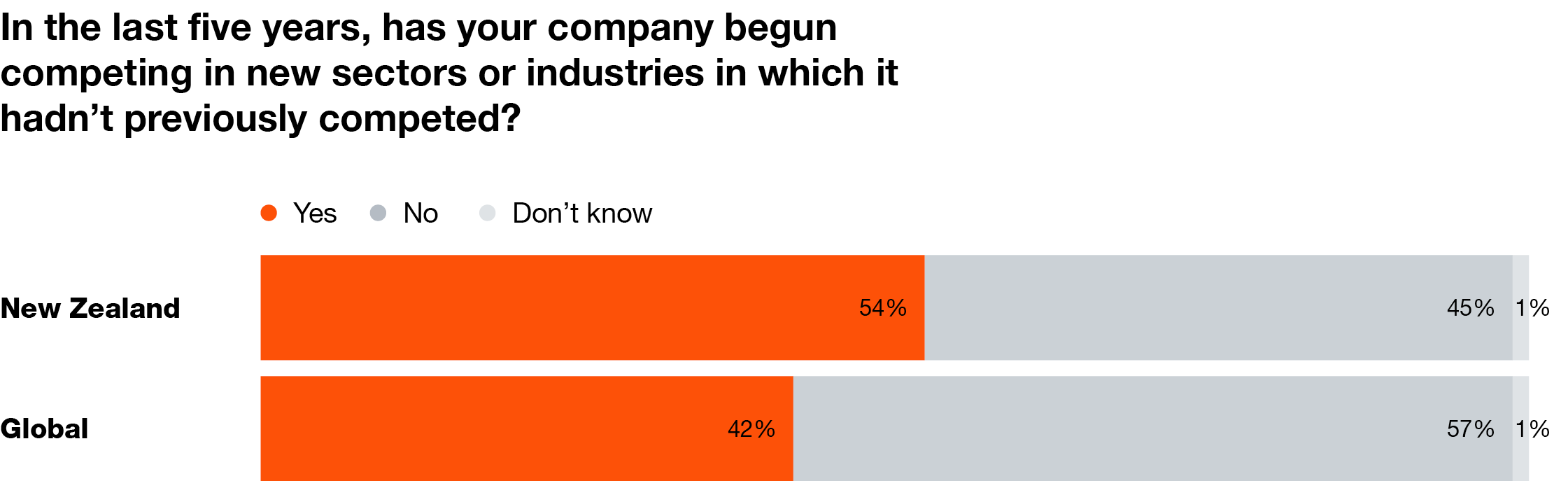
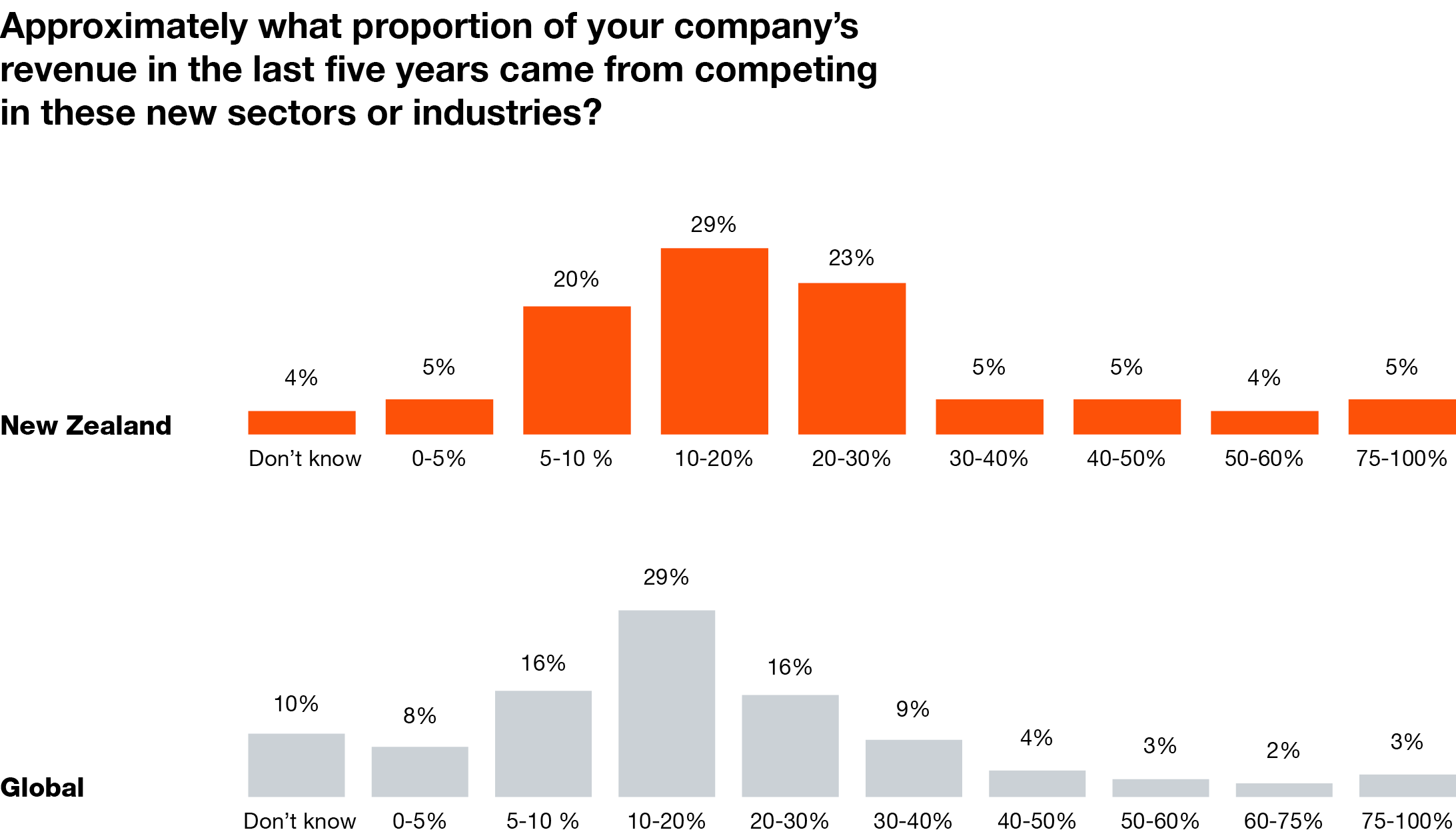
New Zealand companies are clearly on the move, with more than half (54%) expanding into new sectors in the last five years, which is more than their peers internationally (42% of Global CEOs). However, this diversification has yet to translate into material financial impact: only 19% report that new activities contribute more than 30% of total revenue.
Growth ambitions are relatively cautious, with fewer than half planning major acquisitions over the next three years. Where acquisitions do occur, they are primarily defensive or consolidative, as three-quarters (76%) are aimed at increasing market share and 57% at achieving scale efficiencies. A minority are motivated by gaining access to new capabilities (27%), and technology and intellectual property (22%). This suggests there is a significant opportunity to maximise revenue potential post‑deal by leveraging new strategic connections and capabilities secured through acquisitions.
When asked about what is inhabiting their company’s operational performance, CEOs cite access to capital (43%), technology constraints (30%) and organisational design (28%). Meanwhile, only 13% of New Zealand respondents cite having an innovation or venturing function to a large/very large extent. And less than a quarter (21%) say new products and services have contributed to more than 30% of total sales in the past three years.
Innovation is widely recognised as as strategically important with 72% of local CEOs rating it as moderately to extremely vital.
Unsurprisingly, the challenging local economic environment is resulting over a third of New Zealand respondents (43%) reporting that demand generation is below expectations, which is a higher percentage than their global peers (31%). Overall, companies are moving quickly to market with new products and services (50% of respondents consider they are faster than their peers), while being predominantly focused on short-term horizons, with just 11% dedicating time on activities with a five year, or more, time horizonh acquisitions.


Phil Wheeler
Partner
PwC New Zealand
Many New Zealand companies are actively expanding their footprint, with a strong focus on capturing market share. In a challenging economic environment, this approach makes sense. The next step, and where the real opportunity lies, is to complement this growth with greater focus on innovation, differentiation, and efficiency.
The companies performing best are those encouraging new ways of thinking and building the capability to innovate, even in tough conditions. Maintaining this momentum is critical. As economic conditions improve, companies that have continued to invest in innovation will be best placed to accelerate ahead of the market. We see clear evidence that businesses integrating their reinvention and AI journeys today, will realise tangible benefits within the next three years.
CEOs increasingly recognise that innovation is central to long-term success. The opportunity now is to apply this intent through a two-speed horizon: addressing immediate business priorities while concurrently investing in the capabilities required for the next phase of growth. AI plays a powerful role in enabling this reinvention, but it works best when anchored to a clear reinvention agenda, accelerating outcomes rather than defining them.
Trust remains front and centre
Trust-related issues, especially those stemming from tech initiatives, are on the minds of local business leaders. Over the past year, the leading concerns for New Zealand CEOs have centred on data use and privacy, AI safety and Responsible AI, and the impact of climate change on business performance.
These concerns broadly mirror global trends, although their intensity among New Zealand respondents is generally lower than that expressed by global peers, particularly in areas such as Responsible AI and climate impact.
Meanwhile negative impacts from technology, including AI, remains a major concern for New Zealand CEOs, according to respondents who ranked technology disruption (along with key skills) as the third biggest threat, with 13% considering their company is highly or extremely exposed over the next 12 months. This follows macroeconomic volatility (17%) and inflation (12%).
At the same time, confidence in organisational readiness remains muted. Fewer than half of New Zealand respondents, to a large/very large extent, believe their C-suite is well prepared to lead through disruption (37%), anticipate it early (29%), or capture new opportunities arising from it (25%). This shows up in areas such as cybersecurity, with only a third (31%) of New Zealand respondents expecting their companies to take action to a large or very large extent to improve cybersecurity, as a response to geopolitical risk, in the next three years.
Climate resilience is another weak spot, with fewer than a quarter of respondents, in New Zealand and globally, reporting robust measures to manage climate-related risks while seizing associated opportunities.

Pip Cameron
Partner
PwC New Zealand
Effective CEOs are constantly scanning the environment to understand where operational and reputational risks will come from. By its very nature trust is a defensive play and it’s no surprise that the issues most concerning business leaders in 2026 relate to technology, notably data use, data privacy and AI safety.
That should not, however, stop businesses from taking advantage of the step‑change in productivity and innovation that AI enables. The biggest risk is to do nothing and get left behind.
To confidently pursue tech-powered growth strategies, without compromising on trust, companies need to ensure they have the right guardrails in place. This can only occur with robust AI and data governance that provides responsible oversight without being a handbrake on innovation.
The key is to expect disruption, such as a cybersecurity incident or a climate‑related emergency and be ready to mitigate negative impacts so that your company emerges with its reputation intact.

Karen Shires
Chair
PwC New Zealand
From the Chair
The 29th PwC CEO Survey for New Zealand offers timely insights for Boards of Directors in safeguarding their organisation’s reputation in this new AI world.
As AI adoption accelerates, global findings show that companies with a clear, progressive AI roadmap are pulling ahead. Yet speed must be matched with strong governance.
This dedicated section on trust, provides the data and insights which will assist Boards in working with their CEOs and leadership teams to put the right AI guardrails in place, protecting reputation while enabling innovation and growth.
Download
PwC's 29th Global CEO survey
Survey methodology and notes


