






Explore the data for October to December 2025 New Zealand deal activity round-up
Overall, there were 180 deals announced in 2025, up from 157 in 2024 (up ~15%). In Q4 2025, 49 deals were announced. This represents a 17% increase compared to the 42 deals in Q4 2024. Overall, deal volumes in 2025 suggest renewed momentum in market activity over the year.
The data reveals:
- Trade buyers were the primary drivers of deal activity, comprising 44 of the 49 transactions (90%). Financial investor participation showed steady growth, increasing to five transactions this quarter from three in the preceding quarter.
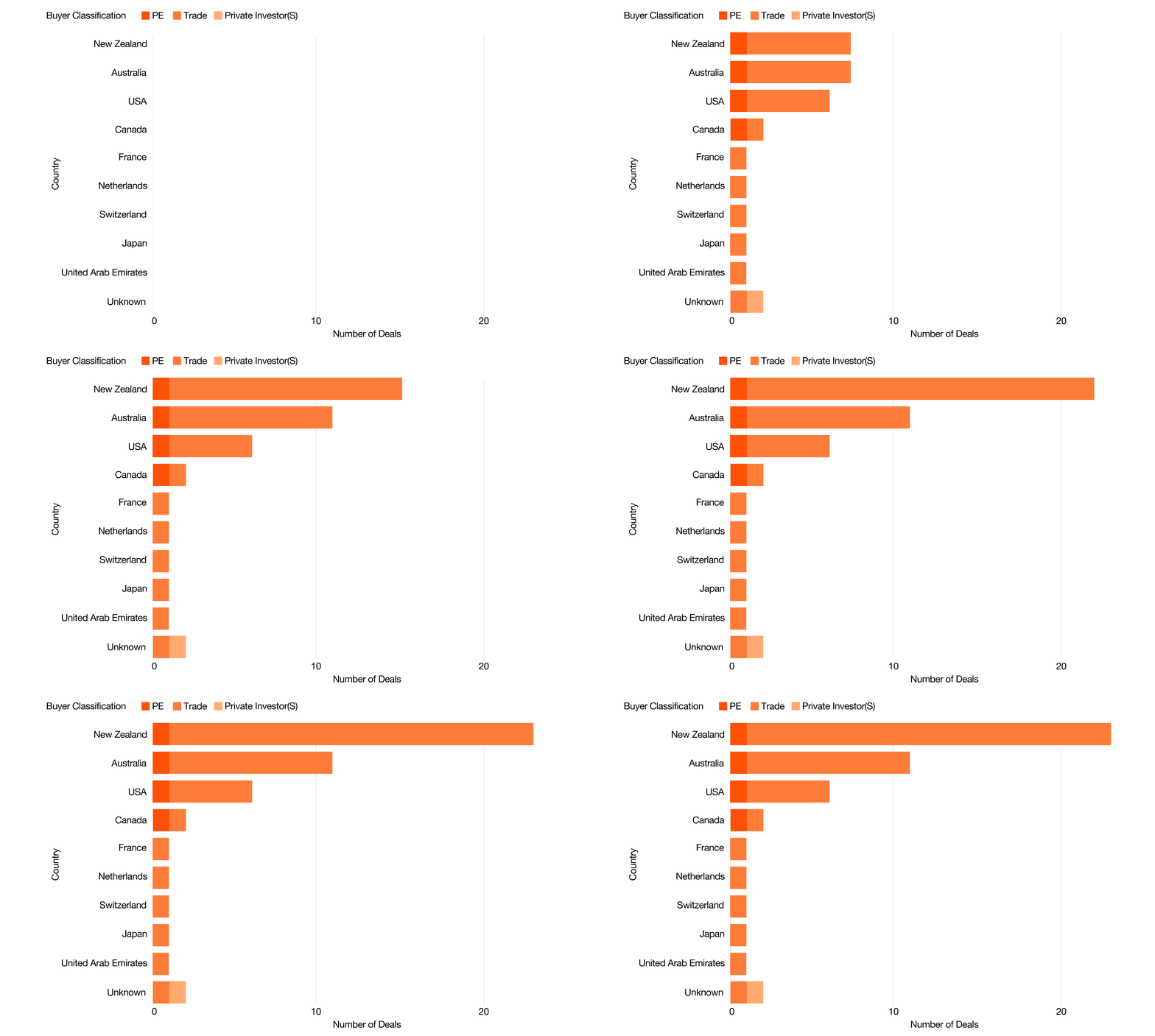
- Overseas buyers accounted for 53% of transactions, reflecting continued international interest in New Zealand. Australia and the United States were the leading sources of offshore activity, participating in 11 and six deals, respectively.
- The Financial Services sector led transaction activity with eight deals, ahead of the Technology, Media and Telecommunications sector, which recorded seven.
Number of deals per quarter 2021 to 2025

Deals by sector and buyer type

Deals by country and buyer type
Note:
The data has been filtered to exclude: (i) real estate transactions; (ii) early stage venture capital transactions where size is stated or estimated to be less than $1.5 million; (iii) transactions announced but yet to complete; (iv) other transactions where applicable.
Sources: Mergermarket, CapitalIQ, Eikon, Pitchbook, PwC analysis (2 February 2025)
M&A environment Value creation plans key to successful M&As
M&A Quarterly - Q4 2025 - Phil Wheeler
The idea that it takes years to become an overnight success certainly applies to our current M&A environment. We have seen a clear shift to sellers developing structured value creation programmes up to two years before they are ready to go to market.
This shift reflects the reality of the last three years, where transactions have been more challenging to execute, and buyers more selective. Sellers have looked for ways to differentiate their asset from comparable opportunities, and a well-articulated value creation plan has become one of the most effective ways to do this.
What today’s buyers are looking for
Effective value creation plans address a wide range of strategic levers, with the most typical being:

Opportunities to grow into new markets or adjacencies, including offshore.

Further optimisation of national operating models, including retail footprints.

Exit or reshaping parts of the business that have not been delivering acceptable returns.
In the recent environment of stagnant economic growth, the interest of potential buyers has been primarily raised by the seller articulating how their offering can boost growth. Cost-out opportunities still appeal, but in many cases these efficiency gains have already been captured and so the incremental benefits are lower.
Taking time to consider the future
Sellers and their management teams are taking the time to analyse market conditions, determine underlying performance drivers, and present growth opportunities in a structured and objective way.
They are also being more deliberate about seeking out the right investors and gaining an understanding of what they will value most.
Value creation plans are also being more commonly seen in merger opportunities, with the two proponents working together to develop a view of the future, and a plan that the two companies can execute together. Value creation plans provide additional rigour for synergy discussions with the benefits to all stakeholders – owners, management, customers, and suppliers – often being considered.
Once the assessment of value creation opportunities is complete, businesses are then prioritising opportunities and making much clearer choices on where to spend resources, and what to pause. They are setting out a roadmap that distinguishes the value that can be delivered ahead of a transaction and the value that is expected to be realised post-transaction.
This establishes a long-term pathway for the business, often articulating a credible route that reinvents the current business model so that it is future fit.
We have also seen an increased focus on value potential from ESG initiatives, shifting the focus from compliance-driven sustainability. At the same time, businesses are actively considering the role of technology and AI, specifically where it has the potential to reshape operating and commercial models in the longer term through new ways of serving customers and scaling the business. This is particularly important as stakeholders place greater weight on trust, transparency and purpose.
These value creation plans are providing a means to sharpen the investment thesis, often leading to better engagement, more bidders, and stronger momentum through a transaction.
The benefits solidify in the transaction
Ultimately, transaction outcomes are the key objective, and owners are open to investing now in value creation to help enable them to get a stronger exit.
They are providing a strong foundation for the Information Memorandum and support a more focused and prepared data room. In some of our recent work, value creation plans are creating opportunities for management to rethink their business and are providing them with greater confidence that their proposition is aligned to the market.
The new expectation
Taken together, these trends reinforce a clear point: value creation is no longer optional for those sellers, or merger parties, wanting to maximise their outcomes. Management teams that invest in the programme early, make and then stick to clear strategic choices, and articulate a credible pathway to sustained value are better positioned to stand out, engage the right investors and achieve stronger transaction outcomes.
About the Author

Global perspectives
The PwC Global M&A industry trends: 2026 outlook provides insights into why, despite ongoing macroeconomic uncertainty, global M&A activity remains significant, particularly at the top end where megadeals dominate deal value. It explains how companies are navigating a complex backdrop of geopolitical tensions, capital allocation choices and rapidly evolving technologies such as artificial intelligence (AI). This has created a ‘K-shaped’ market where well-capitalised buyers pursue large strategic transactions, while smaller and mid-market activity remains more cautious.
For New Zealand dealmakers, many of these global themes resonate locally. PwC New Zealand’s own M&A quarterly updates show a cautious but persistent market, with domestic deal activity continuing as local companies adapt strategies in response to AI and global uncertainty. Deals in New Zealand reflect a shift toward pragmatic execution rather than waiting for ideal conditions, mirroring the global focus on resilience and strategic prioritisation.
The report includes in-depth analysis of significant sectors, exploring major trends, including how technologies such as AI are reshaping the competitive landscape. Check out the industry reports below.
LSEG, rank by number of deals PwC has been the number one mid-market M&A advisor in New Zealand for the last twenty years.
How PwC can help
PwC New Zealand’s Corporate Finance and M&A team is the largest in New Zealand, with a proven track record across a diverse range of sectors. With a nationwide presence led by nine partners, we offer a full range of M&A advisory services including support for divestments, acquisitions, capital raisings and strategic reviews.
Our links to the global network of PwC firms provides relationships with key global market participants, and our close relationship with our Australian colleagues ensures a comprehensive understanding of the Australasian marketplace.
Our M&A team has been ranked the number one firm in New Zealand for the amount of M&A deals by Thomson Reuters (now LSEG) for the last 20 years.
Subscribe to M&A Quarterly Update
Get the latest news on M&A activity in New Zealand every quarter.
Contact us
Partner, Deals - Corporate Finance & Infrastructure, Wellington, PwC New Zealand
+64 21 242 6075
Managing Partner, Te Waipounamu and China Business Group Lead, Canterbury, PwC New Zealand
+64 21 616 232


